
Chemometric Calibration 

Chemometric Calibration Development for Online NIR & UV-Vis Process Analyzers

The performance of every NIR or UV-Vis process analyzer depends on the quality of its chemometric calibration model.

Process Insights develops and supports robust chemometric models that convert spectral measurements into accurate process values such as concentration, moisture, octane number, acid number, color, density, viscosity, and numerous other chemical and physical properties.

Whether you’re implementing a new online analyzer or optimizing an existing process spectroscopy system, our application specialists help ensure reliable long-term analyzer performance through proven calibration development and ongoing model optimization

What Is Chemometric Calibration?

Chemometric calibration is the mathematical relationship between spectral data collected by a process analyzer and laboratory reference measurements.

Using advanced multivariate statistical techniques, chemometric models transform NIR or UV-Vis absorbance spectra into meaningful engineering values that operators can use for process control.

Examples include:

  • Chemical concentration
  • Moisture content
  • Density
  • Viscosity
  • Octane number
  • Cetane number
  • Acid number
  • Color
  • Polymer properties
  • Blend composition
  • Reaction endpoint
  • Product quality

Why Chemometric Models Matter

Without a properly developed chemometric model, even the most advanced spectrometer cannot provide accurate process measurements.

High-quality calibration models enable:

  • Higher prediction accuracy
  • Improved process control
  • Better product consistency
  • Reduced laboratory testing
  • Faster production decisions
  • Improved process yields
  • Lower operating costs
  • Long-term analyzer stability
  • Easier analyzer deployment across multiple production lines

Approach 1 – Laboratory Sample Model Development

Provide representative process samples and laboratory reference data before analyzer delivery.

Process Insights develops a starter chemometric model prior to installation.

Best for:

  • Stable manufacturing processes
  • Existing laboratory datasets
  • Faster analyzer startup

Approach 2 – Commissioning Sample Development

Collect and store process samples prior to analyzer installation.

Reference laboratory values and analyzer scans are combined during commissioning to develop a pre-calibrated model.

Ideal when representative process samples are available but a finalized calibration has not yet been created.

Approach 3 – Online Training Mode

For new or evolving processes, the analyzer operates in training mode while simultaneously collecting spectra and laboratory reference values.

This approach creates calibration models directly from actual operating conditions and often delivers the highest long-term accuracy.

Where appropriate, existing library models can provide interim measurements until the final calibration is completed.

Building a Starter Chemometric Calibration

The initial calibration is typically referred to as a starter model. The difficulty of building a successful calibration depends on the complexity of the process stream and the quality of the lab reference data. To ensure customer success, we have three recommended procedures for collecting, organizing, and analyzing the data to build a starter chemometric model.
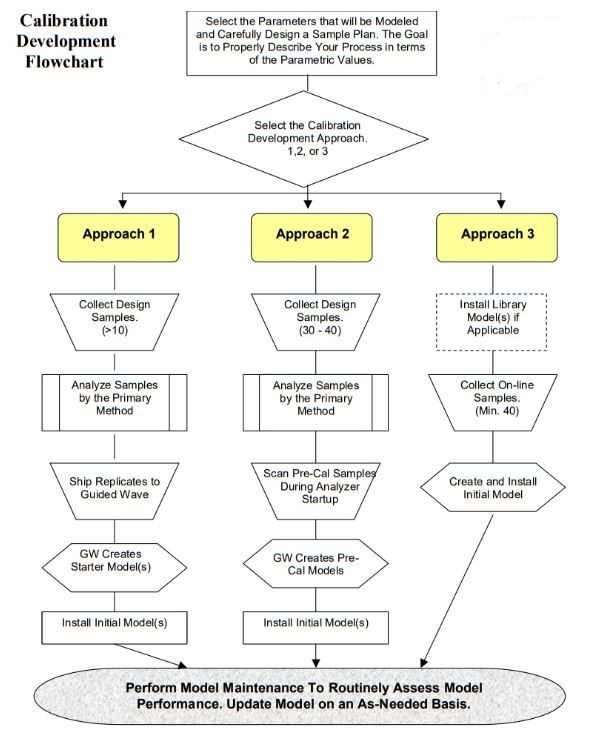
Flowchart overview of the three recommended methods for collecting, organizing and analyzing the data to build a starter chemometric model

To Top