Hydrogen contamination can affect semiconductor manufacturing, specialty gas production, calibration gas preparation, and research processes long before conventional analytical methods detect a problem.
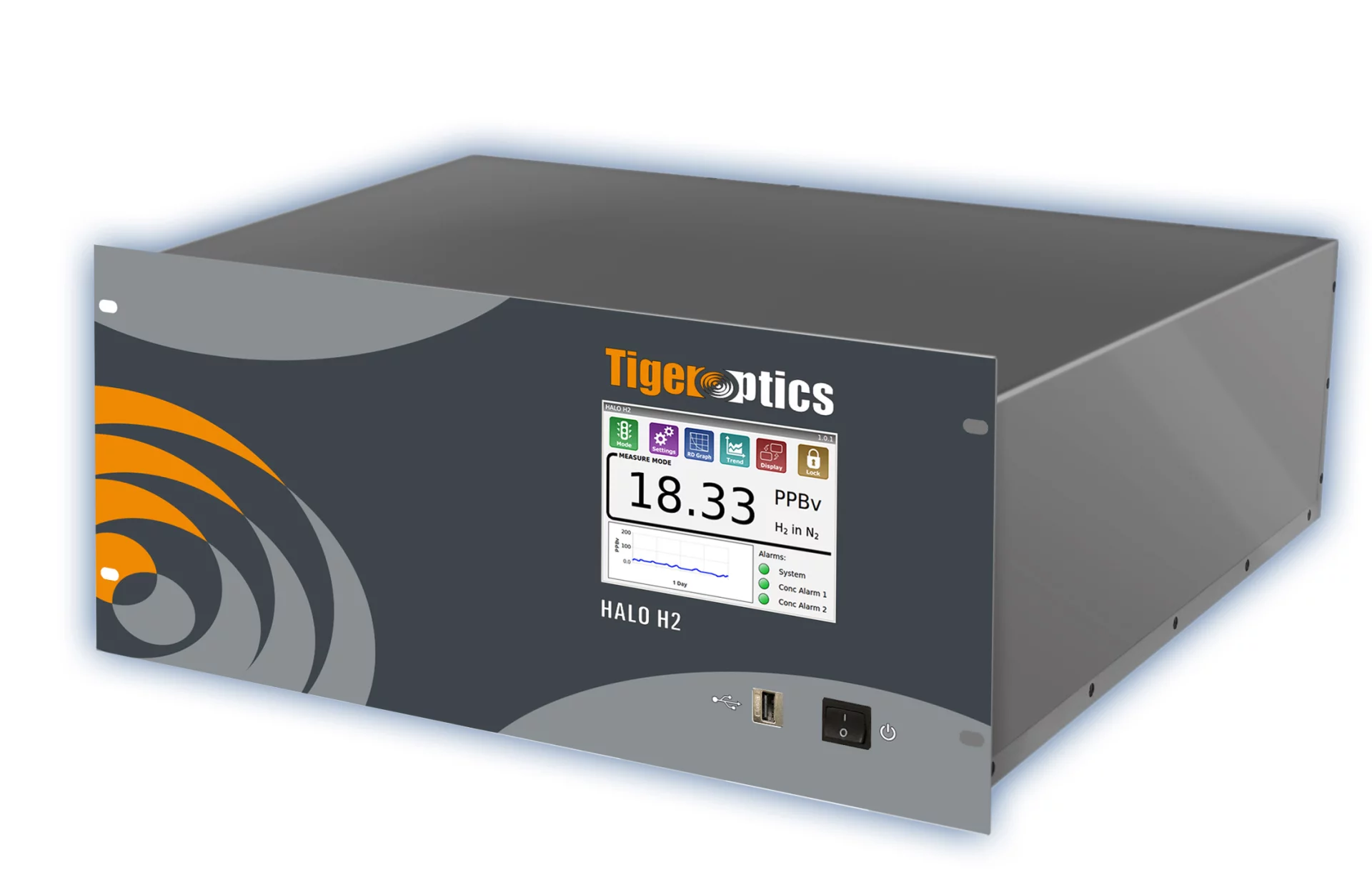
The TIGER OPTICS™ HALO H₂™ uses patented Cavity Ring-Down Spectroscopy (CRDS) combined with catalytic conversion technology to continuously measure trace hydrogen with exceptional sensitivity, stability, and speed. Delivering detection limits from the low parts-per-billion range down to sub-ppb levels for selected inert gas applications, the HALO H₂ provides real-time hydrogen purity verification without routine calibration gases, making it ideal for continuous quality control of ultra-high-purity gases.
THE HALO H2 HYDROGEN ANALYZER DELIVERS REAL VALUE
- Low parts-per-billion (ppb) detection capability with Standard Model
- NEW: Low-Range Model with parts-per-trillion (ppt) detection limits in inert gases
- Extremely fast speed of response
- Wide dynamic range
- Absolute measurement (freedom from need for calibration gases)
- Low maintenance and cost of ownership
- Compact, portable package, ideal for both fixed and mobile cart installation
- Direct measurement in many matrices, including oxygen
Why Choose the HALO H₂?
Benefits
- Continuous trace hydrogen monitoring
- CRDS laser-based measurement
- Detection to 0.3 ppb (standard) and as low as 0.10 ppb for selected low-range inert gas applications
- Calibration-free absolute measurement
- Patented catalytic conversion technology
- Fast response
- Wide dynamic range
- Drift-free operation
- No moving parts
- Built-in zero verification
- Low maintenance
- Low cost of ownership
- Compact platform
- Mobile GO-cart compatible
- Ethernet connectivity
- Remote operation using Serani™ Max software
APPLICATIONS


DETECTION CAPABILITY
|
Detection and Matrix |
Range |
LDL (3σ) |
Precision (1σ) @ zero |
|
Standard Model (requires 1% O2, 99% N2 mixture or CDA utility gas) |
|||
|
H2 in N2 |
0 – 500 ppm |
8 ppb |
3 ppb |
|
H2 in Ar |
0 – 200 ppm |
6 ppb |
2.0 ppb |
|
H2 in He |
0 – 125 ppm |
4 ppb |
1.5 ppb |
|
H2 in Ne |
0 – 140 ppm |
4 ppb |
1.5 ppb |
|
CDA Model (requires pure N2 utility gas) |
|||
|
H2 in Clean Dry Air (CDA) |
0 – 5000 ppm |
80 ppb |
30 ppb |
|
Detection and Matrix |
Range |
LDL (3σ) |
Precision (1σ) @ zero |
|
Low-Range (LR) Model: Inert Gas (requires 1% O2, 99% N2 mixture or CDA utility gas*,‡) |
|||
|
H2 in N2 |
0 – 20 ppm |
0.3 ppb |
0.1 ppb |
|
H2 in Ar |
0 – 9 ppm |
0.13 ppb |
0.05 ppb |
|
H2 in He |
0 – 4.0 ppm |
0.10 ppb |
0.04 ppb |
*
Gas supply purity requirements: <10 ppm H2O, <0.1 ppm H2 †
Gas supply purity requirements: <1 ppm H2O, <1 ppb H2 ‡
Requires inert-gas-specific Zero Gas Panel and Linear Fit Mode
SPECIFICATIONS
| Performance | |
|---|---|
| Operating range | See Detection Capability table |
| Detection limit (LDL, 3σ/24h) | See Detection Capability table |
| Precision (1σ, greater of) | ± 0.75% or 1/3 of LDL |
| Accuracy (greater of) | ± 4% or LDL |
| Speed of response | To be determined |
| Environmental conditions | 10°C to 40°C, 30% to 80% RH (non-condensing) |
| Storage temperature | -10°C to 50°C |
| Gas Handling System and Conditions | |
| Wetted materials | 316L stainless steel, 10 Ra surface finish |
| Leak tested to | 1 x 10⁻⁹ mbar l / sec |
| Gas connections | 1/4” male VCR inlet and outlet |
| Sample inlet pressure | 10 − 125 psig (1.7 − 9.6 bara) |
| Sample flow rate | 0.5 slpm (± 20%) |
| Sample gases | Most inert matrices |
| Gas temperature | Up to 60°C |
| Utility gas supply* | see Detection Capability table for required gas |
| ~15 sccm, 20 − 125 psig | |
| Dimensions, H x W x D | |
| Standard sensor | 8.73″ x 19.0″ x 23.6″ (222 mm x 483 mm x 599 mm) |
| Weight | |
| Standard sensor | 45 lbs (20.4 kg) |
| Electrical and Interfaces | |
| Platform | Max series analyzer |
| Alarm indicators | 2 user programmable, 1 system fault, Form C relays |
| Power requirements | 90 − 240 VAC, 50/60 Hz |
| Power consumption | 200 Watts max. |
| Signal output | Isolated 4−20 mA |
| User interfaces | 5.7” LCD touchscreen, 10/100 Base-T Ethernet |
| USB, RS-232, RS-485, Modbus TCP (optional) | |
| Data storage | Internal or external flash drive |
| Certification | CE Mark |
| Patents | |
| U.S. Patent #7,277,177 • U.S. Patent # 7,255,836 | |
*Utility gas supply purity requirements: <10 ppm H2O and H2 impurities
SALES | TRAINING INQUIRIES
AMERICAS: info.americas@process-insights.com
EMEAI (includes India): info.emeai@process-insights.com
APAC: info.apac@process-insights.com
CHINA: info.cn@process-insights.com
Why CRDS for Hydrogen Analysis?
Unlike many conventional analyzers, Cavity Ring-Down Spectroscopy (CRDS) provides direct optical measurement with outstanding sensitivity, exceptional long-term stability, and rapid response. The HALO H₂ combines CRDS with a patented catalytic conversion technique to safely convert hydrogen into water for highly sensitive optical detection, enabling continuous hydrogen purity measurements without routine calibration gases.
Why Continuous Hydrogen Monitoring?
Continuous monitoring helps users:
- Detect contamination before product loss
- Verify gas purity in real time
- Reduce process downtime
- Improve quality assurance
- Support ISO and customer quality programs
- Reduce manual sampling
- Protect semiconductor yields
- Improve production consistency

TIGER OPTICS | ultra high purity gas moisture analyzers
CQC / IQC Cabinet Total Monitoring Solution

VeraSpec™ APIMS

GO-cart™ for AMC Monitoring

GO-cart™ for Analytical Monitoring

HALO Max QCL™ CO2

HALO Max QCL™ CO
HALO KA™ H2O

HALO KA Max™ CH4

HALO KA Max™ H2O

HALO KA Max™ NH3

T-I Max EtO™

HALO™ 3 CH2O

HALO™ 3 CO

HALO™ 3 CO2
HALO™ 3 D2O/HDO

HALO™ 3 H2O

HALO™ 3 CH4

HALO™ 3 HCl

HALO™ 3 NH3

HALO 3 HF

HALO™ H2
HALO™ H2O in N2O

HALO™ OK/OK+

HALO™ LP H2O

HALO™ RP

HALO™ QRP
Spark™ H2O

Spark™ H2O in CO2

Spark™ CH4

Spark™ C2H2

Spark™ CO2

Spark+™ CO

Spark Max™ CO2

Prismatic 3™

Prismatic 3+™
T-I MAX™ AIR GHG

T-I MAX X3

T-I MAX™ HCl

T-I MAX™ HF

T-I MAX™ NH3
T-I MAX™ CEM

CO-REKT™

ALOHA+H2O™
